Ever found yourself scrambling for words, racing against the clock, and then fiercely defending your creative genius? Welcome to the wild, wonderful world of Scattergories! Mastering the core Scattergories game rules & setup is your first step to becoming a wordplay wizard. This guide will walk you through everything, from unboxing to declaring victory, ensuring you're ready to dive into the fast-paced fun without a hitch.
Before we jump into the nitty-gritty, here's a quick overview of what you'll learn:
At a Glance: Your Scattergories Starter Pack
- Core Goal: Be the quickest to fill your list with unique answers starting with a specific letter.
- Key Components: Folders, answer pads, 20-sided letter die, timer, die-rolling board, pencils, category cards.
- Setup Simplicity: Each player gets a folder, answer sheet, and pencil; ensure everyone uses the same category list.
- Gameplay Loop: Roll a letter, set a 3-minute timer, write unique answers for 12 categories.
- Scoring: 1 point for each unique and acceptable answer.
- Winning: Most points after three rounds wins the game.
- Crucial Rule: Answers must fit the category and start with the key letter.
What Exactly is Scattergories?
Scattergories is a beloved creative-thinking word game that challenges players to come up with unique answers within specific categories, all starting with a designated letter, before a timer runs out. It's a game of quick wits, broad knowledge, and a little bit of luck (with the die roll!). Whether you're a seasoned wordsmith or just looking for a lively group activity, Scattergories offers endless entertainment and a surprising amount of strategic depth.
The beauty of Scattergories lies in its blend of simplicity and challenge. The rules are straightforward enough for new players to grasp quickly, yet the dynamic of finding unique answers keeps even veterans on their toes. It's less about perfect spelling and more about creative interpretation and rapid recall.
Unboxing Your Fun: What's in the Box?
Before you can start outsmarting your friends, let's make sure you know your components. While minor variations exist between editions, a standard Scattergories game set typically includes:
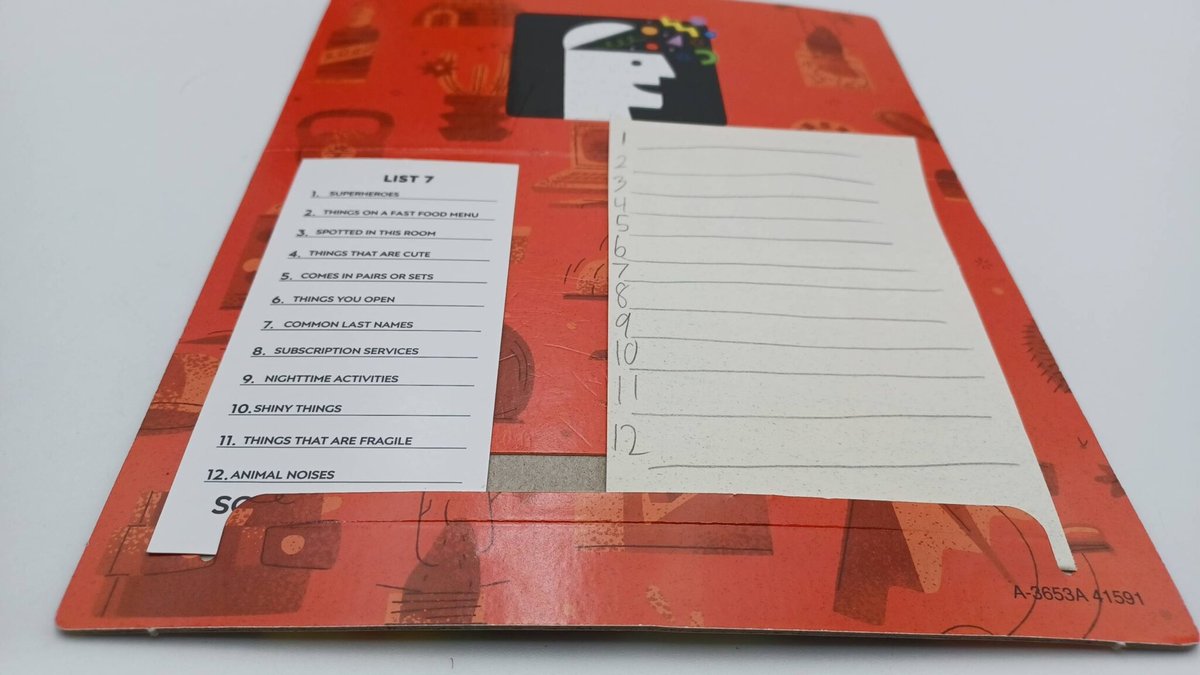
- 6 Folders: These handy tri-fold cardboard sleeves hold your category list and answer sheet, keeping your brilliant (or not-so-brilliant) answers private until scoring.
- 6 Answer Pads/Sheets: Each pad contains numerous sheets, double-sided, with columns for three rounds per game. These are your canvases for word creation.
- 1 20-Sided Letter Die: This iconic die, specifically designed for Scattergories, features a different letter on each face (excluding less common starting letters like Q, U, V, X, Y, Z for fair play).
- 1 Timer: Usually a 3-minute sand timer, though some newer versions might feature an electronic timer. This is your nemesis, ticking down precious seconds.
- 1 Die-Rolling Board: A small, raised plastic board designed to contain the die when rolled. Crucial for keeping the heavy die from bouncing off the table and potentially damaging surfaces or people.
- 6 Pencils: Standard pencils for jotting down your responses.
- Category Cards: These double-sided cards contain 12 distinct categories per side. The number of cards varies; some editions have 48 cards (96 lists!), others fewer. Each card is numbered for easy reference.
Knowing your tools is the first step to mastering the game. Now, let's get everything organized.
Getting Ready to Play: Scattergories Setup
Setting up Scattergories is a breeze, getting you into the action quickly. Think of it like preparing your battle station for a verbal duel.
Step-by-Step Setup Guide
- Distribute Essentials: Each player needs a folder, one answer sheet (from the pad), and a pencil. Make sure everyone has their supplies ready.
- Choose Your Categories: Decide which category card you'll use for the game. Each card has two lists, front and back, usually labeled with a list number (e.g., List #1, List #2).
- Load the Folders: Carefully insert one answer sheet into each player's folder, ensuring the first column is ready for writing. Then, slide the chosen category card into the folder.
- Confirm Alignment: This step is crucial! Ensure all players are using the exact same category list number. The number should be clearly visible in each player's folder. A quick "Are we all on List #4?" around the table prevents mix-ups.
- Place the Die and Board: Set the 20-sided letter die and the die-rolling board in a central location, accessible to all players. Remind everyone to roll the die only on the board to avoid mishaps.
- Ready the Timer: Place the timer nearby. If it's a sand timer, make sure it's lying on its side, ready to be flipped. If it's electronic, ensure it's charged and set for 3 minutes.
With everyone set, folders ready, and pencils poised, you're officially ready to begin your Scattergories adventure!
Let the Letters Fly: How to Play Scattergories
Scattergories is typically played over three rounds. Each round follows a consistent structure, building anticipation and excitement.
The Round Structure: Your Core Gameplay Loop
- Verify Your List: At the start of each round, everyone should briefly check their folder to confirm they're still on the agreed-upon category list number. This prevents any stray list-flipping incidents.
- Roll the Letter Die: One player takes on the important task of rolling the 20-sided letter die. They must roll it on the die-rolling board and then clearly announce the letter that lands face up. This letter is your "key letter" for the entire round. For instance, if 'P' is rolled, every answer you write this round must start with 'P'.
- Start the Timer: As soon as the letter is announced, someone flips the 3-minute sand timer or presses START on the electronic timer. The clock is now ticking!
- The Brainstorm Blitz: This is where the magic happens. All players, simultaneously and silently, race to fill in the first available column on their answer sheet. For each of the 12 categories, you need to come up with an answer that fits the category and begins with the key letter.
- Example: If the key letter is 'B' and a category is "Things Found in a Kitchen," you might write "Blender," "Baking Soda," or "Bread."
- Time's Up!: When the timer runs out, all players must immediately stop writing. No last-second scribbles allowed! This rule is crucial for fair play.
Once the frantic writing ceases, it's time for the moment of truth: scoring.
The Moment of Truth: Scoring Your Round
Scoring is where your cleverness truly pays off – or where you realize everyone else had the same "brilliant" idea.
Step-by-Step Scoring
- Player 1 Reads: Starting with the player who rolled the die (or another agreed-upon order), the first player reads their answers aloud, one category at a time.
- Mark Your Sheet: As each player reads their answers, all other players listen intently and mark their own answer sheets.
- If your answer matches another player's answer for the same category, both you and the other player cross out that answer on your sheets. It scores zero points for everyone who wrote it.
- If your answer does not match any other player's answer for that category (and it's acceptable), you circle it on your sheet. This answer scores 1 point for you.
- Address Challenges: During this reading phase, if any player questions the acceptability of an answer (e.g., "Does 'Orange' really count as 'Food' if the letter is 'O'?", or "Is 'The Big Apple' acceptable for 'Cities' with 'B'?"), they can challenge it. We'll cover challenged answers in detail shortly.
- Rotate and Repeat: Once the first player has read all 12 of their answers, the next player reads their answers, and the process repeats until everyone has read their full list.
- Tally Your Points: After all 12 categories have been scored by everyone, each player counts the number of circled answers on their sheet for that round. This is their round score. They then record this total at the top of the column.
Remember, the goal isn't just to fill every blank; it's to fill them with unique answers that no one else thought of!
Navigating Controversies: Challenged Answers Explained
Even the most straightforward answers can sometimes spark debate. The Scattergories rules include a fair system for resolving these challenges.
How to Handle a Challenge
- The Challenge: If you believe another player's answer doesn't fit the category, doesn't start with the key letter, or is otherwise invalid according to the rules, you can voice a challenge.
- The Vote: Once an answer is challenged, all players—including the player whose answer is being challenged—participate in a vote.
- A thumbs-up indicates the answer is acceptable.
- A thumbs-down indicates the answer is not acceptable.
- Majority Rules: The majority vote decides the fate of the answer. If more players give a thumbs-up, the answer stands (and can be scored). If more give a thumbs-down, the answer is disallowed and scores zero points.
- Tie-Breaker: In the event of a tie vote, the player whose answer was challenged does not get their vote counted. The remaining votes determine the outcome. This ensures impartiality.
Challenges add a fun, interactive layer to the game, often leading to humorous discussions and unexpected rulings. Don't be afraid to defend your clever answers!
Beyond One Round: Continuing the Game & Winning
Scattergories isn't a one-and-done affair; it's a multi-round showdown.
Starting a New Round
After completing and scoring a round, you're ready for the next one:
- Keep the Same List: For rounds two and three, you typically continue using the same category card list that you used for round one. Simply move to the next blank column on your answer sheet.
- Roll a New Letter: The designated player rolls the 20-sided letter die again to get a new key letter.
- Important: If the same letter is rolled twice during the same game (across any of the three rounds), reroll the die until a different letter appears. This keeps the game fresh.
- Reset the Timer: Flip or start the timer for 3 minutes, and the scramble begins anew!
You'll repeat the "Roll, Timer, Write, Score" cycle for a total of three rounds.
The End of the Game
- Total Your Scores: After all three rounds are played and scored, each player adds up the points from all three columns on their answer sheet. This is their grand total score.
- Declare the Winner: The player with the highest total score wins the game! Bragging rights officially earned.
- Tie-Breaker Round: If two or more players end up with the exact same total score, they engage in a tie-breaker. These players play one additional round, following all the standard rules (new letter, 3-minute timer, same category list). The player among the tied participants who achieves the highest score in that single tie-breaker round is the ultimate victor.
Master the Details: Official Rules for Acceptable Answers
This is where many Scattergories debates arise, so understanding the nuances of acceptable answers is key to playing fair and strategically.
Core Principles for Valid Answers
- Starts with the Key Letter: The absolute primary rule. The first word of your answer must begin with the key letter rolled for the round.
- Exception: Articles: Articles like "A," "An," and "The" at the beginning of an answer are ignored when determining the starting letter. For example, if the key letter is 'S' and the category is "Movie Titles," "The Shining" is acceptable because "Shining" starts with 'S'. "A Bug's Life" for key letter 'B' works. "An American Tail" for 'A' works.
- Fits the Category: Your answer must logically belong to the category it's written under. This is often subjective, but generally, if you can reasonably argue its fit, it's fair game.
- Uniqueness Within the Round: You cannot use the exact same answer more than once in the same round for different categories.
- Example: If the key letter is 'P' and you have "Presidents" and "Things that are Cold," you can't write "President" for both, even if it fits both. You'd need "Polar Bear" for the second.
- Proper Names Flexibility: For proper names (people, places, titles), you have some leeway:
- You can use either the first name or the last name as the starting point, as long as that chosen name begins with the key letter.
- Example: For key letter 'P' and category "Presidents": "Paul Newman" (using 'Paul') or "Presley, Elvis" (using 'Presley') are both acceptable if they were presidents. "President Obama" for 'O' is fine.
- Important: The name must be relevant to the category. "Paul Newman" isn't a President, so it wouldn't score.
- Creativity is Encouraged (Within Reason): Scattergories thrives on clever and unexpected answers. If your answer is a bit of a stretch but you can justify it, it might just earn you a point. This is where the group vote for challenged answers comes into play.
- Punctuation and Capitalization: Don't worry about perfect punctuation or capitalization; they don't affect scoring. Focus on getting the words down!
Common Pitfalls to Avoid
- Using a Middle Word: Only the first significant word counts. "Great Dane" for key letter 'D' is incorrect; it should be 'G'.
- Too Generic: While "Food" might work for category "Things to Eat," it's unlikely to be unique and therefore won't score. Be specific!
- Illegible Handwriting: If no one can read your answer, it can't be scored. Write clearly under pressure!
Level Up Your Game: Scattergories Variations & House Rules
Once you've mastered the basic Scattergories game rules and setup, you might want to inject some fresh twists. Many groups adopt "house rules" to add challenge, humor, or simply to adapt the game to their preferences.
Here are a few popular variations and considerations:
Official Game Variations (from some rulebooks)
- Extra Points for Double Letters: This one rewards truly clever answers. If your answer is a proper name or title and the key letter appears more than once as the first letter of a word in your answer, you score an additional point for each extra instance.
- Example: Key letter 'R', category "Famous People."
- "Ronald Reagan" = 2 points (R-R)
- "Rembrandt van Rijn" = 3 points (R-R-R)
- This variation makes you think harder about multi-word answers.
- Time Challenge: For a more frantic and challenging game, shorten the timer!
- Try 2 1/2 minutes for a moderate increase in difficulty.
- Go for 2 minutes if you really want to put your brainpower to the test. This rewards quick thinkers and broad general knowledge.
Popular House Rules & Adaptations
- No Plurals: Some groups enforce a rule against using simple pluralizations (e.g., "Cats" for 'C', when "Cat" was already used or feels too easy). This forces more creative word choices.
- Alliteration Bonus (Similar to Double Letters): A simpler version of the official extra points rule. If any two consecutive words in your answer start with the key letter, you get an extra point.
- Specific Letter Removal: While the die already excludes some letters, some groups might choose to remove another letter if it consistently proves too difficult or leads to too many rerolls (e.g., 'J' or 'X' if it's on the die).
- Category Swap: If a specific category consistently stumps everyone or doesn't feel relevant, agree as a group to swap it out for a general wildcard category (e.g., "Anything Goes") or simply skip it for the round.
- Theme Rounds: Instead of random categories, create a themed list! For example, all categories relate to "travel," "food," or "pop culture." This often requires creating custom category lists. If you're looking for an easier way to get diverse and fresh category ideas, you might find it helpful to Access the Scattergories generator to spice up your game nights without manually brainstorming lists.
Experiment with these variations to find what makes Scattergories most enjoyable for your group!
Fresh Start: Setting Up a New Game
Once a game is finished, resetting for another round of fun is quick and easy.
- Remove Used Sheets: Have each player remove their now-filled answer sheet from their folder.
- Flip or Replace Category Card:
- If you want to use the other side of the same category card, simply flip it over and insert it back into the folders. Make sure everyone is using the new List #.
- If you want an entirely new set of categories, choose a different category card and replace the old one in everyone's folder.
- Insert Blank Sheets: Provide each player with a fresh, blank answer sheet (remember they are often double-sided, so you might just flip the used sheet to the blank side).
- Confirm Again: Always double-check that all players are using the same category list number for the new game.
You're now ready for another high-energy Scattergories showdown!
Frequently Asked Questions About Scattergories
We've covered a lot, but a few common questions always pop up.
Can I use the same word for different categories if they both fit and start with the key letter?
No, the official rules state you cannot give the exact same answer more than once in the same round for different categories. Your answers must be unique within the round.
What if the rolled letter is really hard, like 'Z' or 'X'?
The 20-sided die is designed to mostly exclude these letters for fair play. However, if a less common letter (like 'J' or 'K') makes an appearance and your group is struggling, you have a few options:
- Reroll: Officially, you only reroll if the same letter appears twice in one game. Unofficially, some groups agree to reroll particularly tough letters by consensus.
- Get Creative: This is Scattergories' true test! Embrace the challenge and see what wild answers you can invent.
Do I have to spell words perfectly?
No, perfect spelling isn't required. As long as your answer is recognizable and clearly intended to be a specific word, it should be accepted. The focus is on creativity and quick thinking, not spelling bees.
What if I can't think of an answer for a category?
That's okay! You can leave a blank space for that category. It simply means you won't score a point for it. Don't waste too much time dwelling on one category; move on and come back if inspiration strikes.
Can children play Scattergories?
Absolutely! Scattergories is a fantastic game for all ages. Younger children might need a bit more time or some help with more obscure categories, but the core mechanic is very engaging. You can even simplify the game by shortening the category list or extending the timer for younger players.
Maximize Your Wordplay: Your Next Steps
You're now fully equipped with the knowledge of Scattergories game rules and setup. From understanding the components to navigating heated debates over acceptable answers, you have everything you need to host or participate in a thrilling Scattergories night.
Remember, the true fun of Scattergories comes from embracing the challenge, laughing at unexpected answers, and celebrating those moments of pure wordplay genius. Gather your friends and family, set up the game, and prepare for an evening of rapid-fire thinking and uproarious fun!